Cafa AI brings everyday AI tools together in one place. You can chat, upload files, write documents, generate and edit images, create videos, animate photos, make talking-avatar videos, turn text into speech, and improve written text.
Start with what you want to accomplish. Ask Cafa AI a question, describe what you want to create, or add a file that provides useful context. You can then follow up, adjust the result, save your work, or download it from the relevant tool.
Cafa AI can save time and help you explore new ideas, but it can still misunderstand you or produce incorrect details. You remain in control of what you keep, change, and share. Tool access and usage limits may vary by plan.
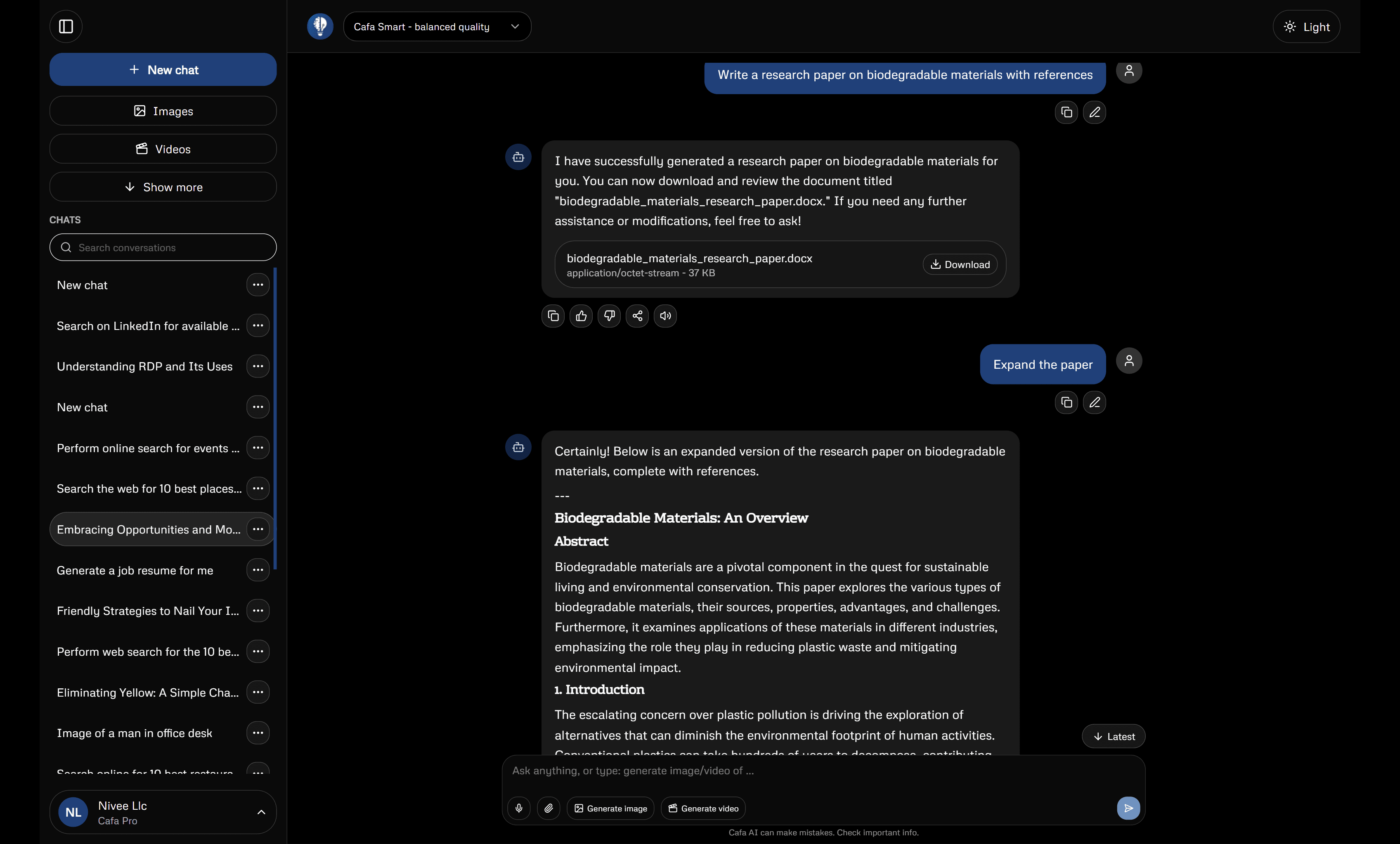
One account, many ways to create
Use Chat when you want to ask questions, understand a topic, brainstorm, write, revise, or discuss an uploaded file. Open a dedicated tool when you want a specific result such as an image, edited picture, video, voice recording, talking avatar, or downloadable document.
Cafa AI is a creative assistant, not a guaranteed source of truth or a replacement for professional judgment. Check important information, make sure you have permission to use uploaded material, and review everything before you share it.
What can Cafa AI do?
Choose the tool that matches what you want to make:
- Chat: ask questions, brainstorm, plan, write, revise, and work with uploaded files.
- Documents and artifacts: turn ideas and source material into structured work you can download.
- Images: create a new picture from a description or edit an image you upload.
- Video: generate a clip, animate a still image, or create a talking avatar from a photo and script.
- Voice: choose an available voice and turn written text into audio.
- Writing Tools: estimate whether text may be AI-written or rewrite it with more natural phrasing.
- History and repositories: return to conversations and find supported images, videos, and files you created.
Who is Cafa AI designed for?
Cafa AI can support students who want explanations and practice, professionals who need a first draft or structured summary, creators developing scripts and visual concepts, and general users exploring ideas or working with files. Those groups should not use it identically.
A student should preserve academic integrity and verify explanations against course material. A business user should minimize confidential input and assign a reviewer. A creator should check facts, originality, likeness consent, and media defects. In every case, the best fit is a user who is prepared to direct and evaluate the result rather than hand over responsibility.
A simple way to work with Cafa AI
First, open the tool that matches your goal. Tell Cafa AI what you want, who it is for, and any details it must follow. Add a file or image only when it helps and you are allowed to share it.
Next, review the first result. Point out exactly what should change and what should stay. When you are happy with it, use your history, repository, or the download button to keep the work.
Chat and writing assistance
Chat can help explain an unfamiliar topic, compare options, generate questions, organize notes, develop an outline, or draft and revise text. Follow-up turns make it possible to clarify a goal and preserve useful context. A strong request names the reader, intended outcome, evidence boundary, and format.
Cafa AI also has dedicated AI-detection and humanization tools. A detection result is an estimate, not proof that a person did or did not write a passage. It can produce false positives and false negatives and should never be the sole basis for an accusation or penalty. Humanization changes phrasing and flow; it should be used as editing assistance, not to conceal prohibited AI use or misrepresent authorship.
Image generation and editing
Open Images and describe the subject, setting, framing, light, colors, and visual style you want. To change a picture you already have, open Edit Image, upload it, and explain what should change and what should stay the same.
Zoom in before saving. Check faces, hands, edges, reflections, logos, and any words in the image. Keep your original upload, ask permission before using a real person's likeness, and never present a generated scene as proof that a real event happened.
Video, Image to Video, and Avatar Video
Use Video to create a short clip from a description. Use Image to Video when you want to add motion to a still picture. Use Avatar Video to turn a photo and script into a talking-person video. For the best result, describe one clear shot, the main action, camera movement, lighting, and mood.
Watch the entire clip before you use it. Generated video can unexpectedly change a face, object, word, or background. Never use it to make people believe a real person said or did something they did not.
Voice and audio
Open Voice, add your script, choose one of the voices available to you, and generate the audio. Write for listening with short sentences and clear transitions. Spell out unclear abbreviations, dates, or numbers, and preview difficult names when possible.
Listen to the whole recording before downloading it. Keep a written version when your audience may need one, and never use synthetic speech to impersonate someone or suggest they said something without permission.
Documents, files, and artifacts
Attach a file in Chat when you want to ask questions about it or use it as source material. Open Documents when you want to build structured work, and use the repository to return to supported artifacts you have saved.
Tell Cafa AI what each file is for and which one matters most if they disagree. Compare summaries with the original. After downloading a document, open it and check the layout, links, page breaks, and images before you send it to anyone.
Practical example use cases
- Learning: ask for a concept explanation followed by practice questions, then verify it against course material.
- Work: turn approved meeting notes into decisions, owners, and open questions without inventing deadlines.
- Writing: create an outline from verified evidence, draft sections, then perform a human line edit.
- Images: explore several compositions for a campaign concept before finishing typography in a design tool.
- Video: animate a clear source image with one restrained subject motion and one camera movement.
- Voice: prepare a short narration, test names and acronyms, then review the full audio before use.
- Documents: build and review a structured brief before generating a downloadable artifact.
Free and paid access
You can explore some of Cafa AI as a guest or with the access included in your account. Paid plans may offer different tools or higher usage limits.
Visit Plans for current pricing, then compare it with the limits shown in your account. Models, voices, and generation limits can vary, so download any work you need to keep.
Responsible AI use
Responsibility begins with the intended effect on other people. Verify factual outputs; avoid stereotypes and unsupported conclusions; respect consent, attribution, and confidentiality; and do not use synthetic media to manufacture evidence or impersonate someone. Clearly consider disclosure when an audience could otherwise misunderstand how a consequential piece of content was produced.
The amount of review should rise with the stakes. Legal, medical, financial, safety, employment, and similarly consequential matters require qualified expertise and appropriate processes. AI can help prepare questions or organize supplied information, but it should not become the sole authority.
Privacy and safe usage considerations
Provide the minimum data required for the task. Do not enter passwords, authentication tokens, unnecessary personal records, confidential client information, restricted research, or proprietary material without explicit authorization. Redact identifiers or use synthetic examples when real data is not needed.
Read Cafa AI’s current privacy policy and follow the rules of the organization, school, client, or data owner involved. A convenient prompt does not override a confidentiality duty. Also review generated output for accidental repetition of sensitive details before it is downloaded or shared.
Limitations of AI-generated content
- Text can contain invented facts, citations, quotations, or links.
- Summaries can remove qualifications and minority viewpoints.
- Writing tools cannot establish authorship or academic integrity with certainty.
- Generated images can contain anatomical, spatial, text, or identity errors.
- Generated video can flicker or change subjects and environments over time.
- Synthetic speech can mispronounce names and apply unnatural emphasis.
- File extraction and exported layouts need comparison with the source and final viewer.
- A confident tone does not indicate reliable evidence or professional expertise.
A few quick answers
You never have to accept the first answer: follow up with the missing detail or start again with a clearer request. You may use a result publicly after checking its facts, permissions, originality, safety, and any disclosure rules. An AI Detector score is only an estimate, not proof of authorship. Features and limits can differ by plan.
Cafa AI can help a teacher, editor, designer, adviser, or other professional with parts of their work, but it cannot replace their experience or responsibility. The person who uses and shares the result makes the final decision.